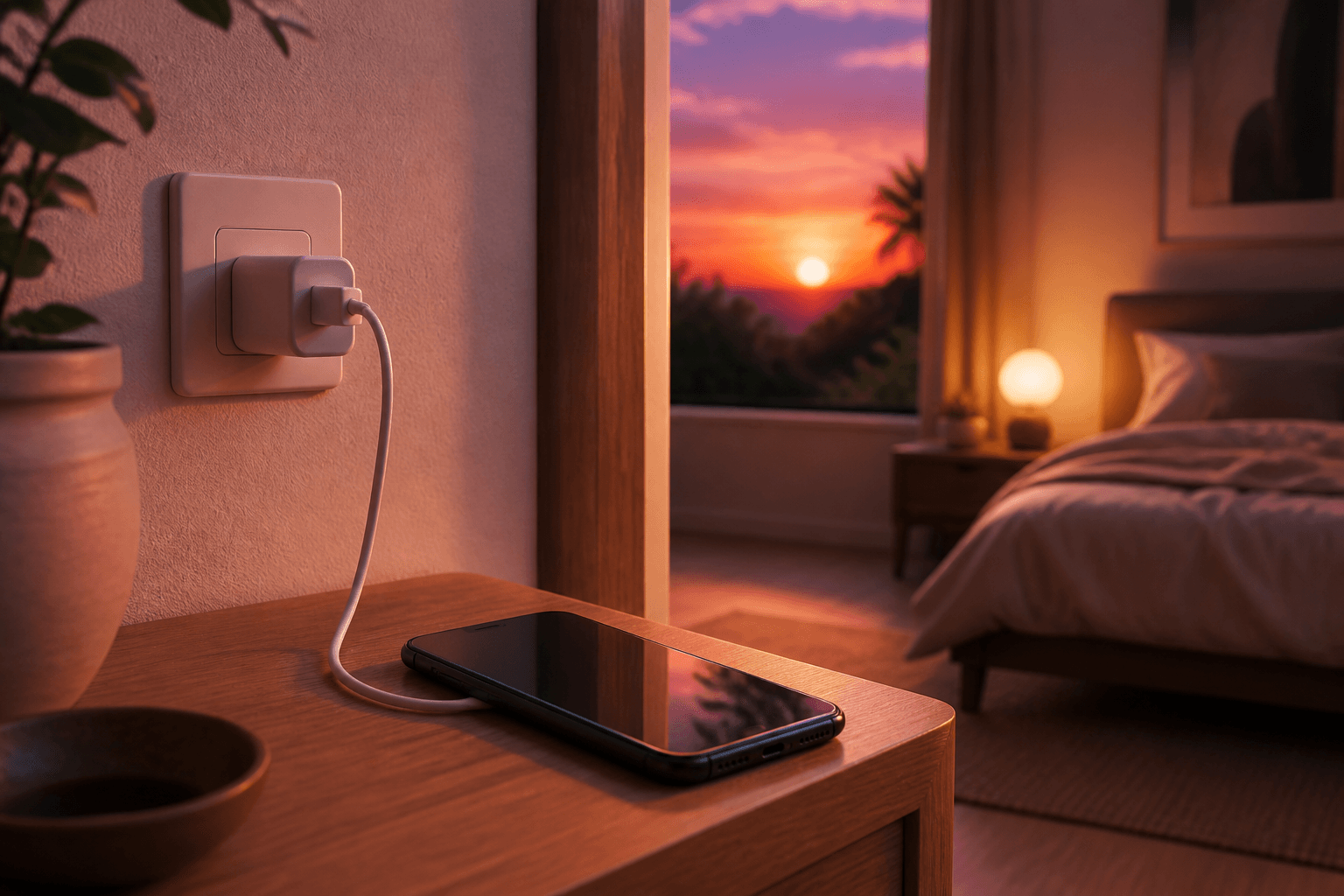
Your brain needs a landing strip before sleep. Phones are terrible landing strips. Infinite feeds keep the nervous system in “one more” mode long after your eyes say they are tired.
A digital sunset is a recurring boundary: screens down on a schedule, with a replacement activity ready so you are not left staring at the wall negotiating with yourself.
What digital sunset is (practically)
Pick a bedtime. Set a recurring alarm 60 minutes earlier. At that alarm:
- Screens begin charging outside the bedroom (or at least outside arm’s reach).
- You switch to a short list of allowed wind-down activities.
- You do not judge the night by streak perfection — you judge it by sleep quality over weeks.
Sixty minutes is a starting template. Some people need 90; night-shift workers need a “pre-sleep” window attached to their sleep time, not the sun.
Replacement menu (choose two, not ten)
Idle hands reopen apps. Pre-commit to a menu:
- Paper reading (page limit helps)
- Light stretching or foam rolling
- Shower / wash-up ritual
- Two-minute tidy of tomorrow’s launchpad (keys, bag, clothes)
- Journaling three lines: “done / grateful / tomorrow’s first step”
- Quiet conversation with a partner (no shared doomscroll on the couch)
Warning: “Just one more reel” is rarely one more reel. If a platform is your usual slip, delete it from the phone for two weeks or log out so friction rises.
Worked example: a week that stuck
Context: Ravi slept at ~12:30 a.m., phone in bed, woke groggy. Wanted 11:30 sleep.
Plan: Alarm at 10:30. Phone charged in the kitchen. Allowed: shower, paper novel, stretch. Laptop stayed closed unless a true work emergency (defined in advance: production down, not Slack curiosity).
Slip protocol: If he broke sunset, he still put the phone outside the bedroom when he noticed — no “well, the night is ruined.”
By day 10, average sleep onset moved earlier by ~35 minutes, and he stopped losing 40-minute chunks to “quick checks.” The metric that mattered was morning alertness scores, not a perfect streak calendar.
14-day install plan
Days 1–3 — Boundary only. Alarm + phone out of bedroom. Keep TV if removing all screens fails; then tighten.
Days 4–7 — Add one replacement. Same activity each night to reduce choice fatigue.
Days 8–11 — Remove the worst app from the phone or use OS focus modes that hard-block after sunset.
Days 12–14 — Review the sleep log and adjust timing by 15 minutes if needed.
Do not optimize blue-light glasses, supplements, and app blockers in week one. Sequence beats gear.
Scripts for shared homes
Partner who wants to watch something
“I’m doing a 10:30 digital sunset so I sleep better. I’m happy to watch with you earlier, or you can keep the show — I’ll switch to paper in the bedroom.”
Roommate / family noise
“If the living room is screen-heavy after 10:30, I’ll take the bedroom wind-down. Not a judgment — just my sleep experiment.”
Yourself at 10:29
“Curiosity is not an emergency. If it’s still interesting tomorrow, it will be interesting after coffee.”
Travel and late nights without abandoning the habit
Hotel rooms and late dinners break perfect schedules. Keep a travel rule: sunset still happens, but the window may shrink to 30 minutes. Charge the phone across the room (closet shelf works). Read a few pages or stretch; skip inventing a new perfect routine in a strange city.
If you get home after your usual alarm, run a compressed sunset: wash up, phone on the charger outside the bedroom, lights down. Partial nights still teach the association “bed ≠ feed.”
Common mistakes and edge cases
Mistake: sunset without replacement. Boredom reinstalls Instagram. Menu first.
Mistake: bed as office + cinema + dinner table. If you must use a laptop late, change rooms for wind-down so bed means sleep.
Mistake: streak shame. Missing two nights does not reset your identity. Resume at the next alarm.
Mistake: negotiating every night. Decision fatigue is how “just tonight” becomes every night. Automate the alarm and the charge station so willpower is not the bottleneck.
Edge case: on-call or caregiving. Define exceptions in writing: which alerts are allowed. Keep a dumb phone or focus filter if possible so only those alerts pierce sunset.
Edge case: living with someone who scrolls in bed. Negotiate light/earbud norms, or use an eye mask and your own charge station. You control your device placement even when you cannot control theirs.
Edge case: anxiety that spikes when the phone is gone. Start with 20 minutes, not 60. Pair sunset with a calming body routine. If anxiety is severe, talk to a clinician — sleep hygiene is not a full treatment plan.
Sunset checklist
- Target bedtime chosen
- Recurring alarm 60 minutes prior
- Charge station outside bedroom
- Replacement menu of two activities
- Exception rules written (on-call, travel)
- Focus mode / app block configured if needed
- Two-week log started
How to measure progress
For 14 nights, log four fields (30 seconds):
- Sunset kept? (Y / partial / N)
- Sleep onset rough time
- Morning restedness (1–5)
- Night awakenings (0 / some / many)
Success looks like: restedness average rising by ≥1 point, or fewer nights with “many” awakenings — even if you only hit full sunset 8 of 14 nights.
Secondary signal: how often you reach for the phone within five minutes of waking. Many people find mornings quieter after evenings get a landing strip.
Digital sunset is not anti-technology. It is pro-sleep and pro-attention. Give your brain a runway, and let the feed wait until tomorrow.